Mighty Arm Excavation provides commercial site grading for GCs and developers across Greater Seattle, taking ground from rough cut to compacted subgrade at the elevations, slopes and tolerances on your plans. We’re a Washington-licensed, bonded and insured sitework subcontractor, and every grading scope carries a one-year workmanship warranty.
Construction site grading turns an excavated site into a buildable one. After our excavation services bring the ground to depth and general elevation, grading shapes, levels and compacts it to the design surface.
As part of our earthwork packages, we grade private commercial buildings, residential subdivisions and plats, condo and townhome pads, roadways and access roads, public works and federal jobs, including sloped and hillside sites. The 22-home site development in Seattle in our portfolio is one example, with over-excavation, structural fill and buildable pads.

Graded to spec-stated tolerances
Prevailing-wage and public-works capable
Scopes that map to CSI Division 31 (31 22 00 Grading)


Our commercial grading work also covers the scopes that go with it: aggregate base placement, geotextile and geogrid installation, curb and gutter subgrade, trench backfill to grade and topsoil placement.
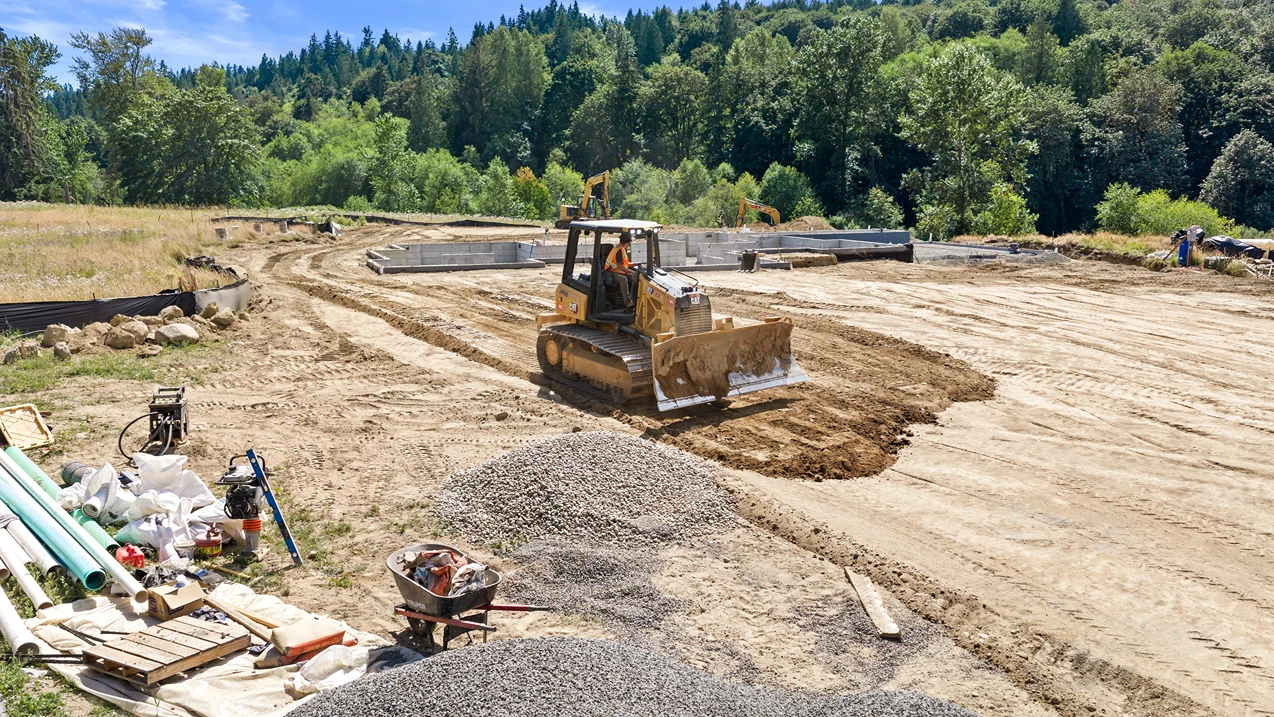
First-pass cut and fill that brings the site to general elevations and sets the direction stormwater will run across the lot.
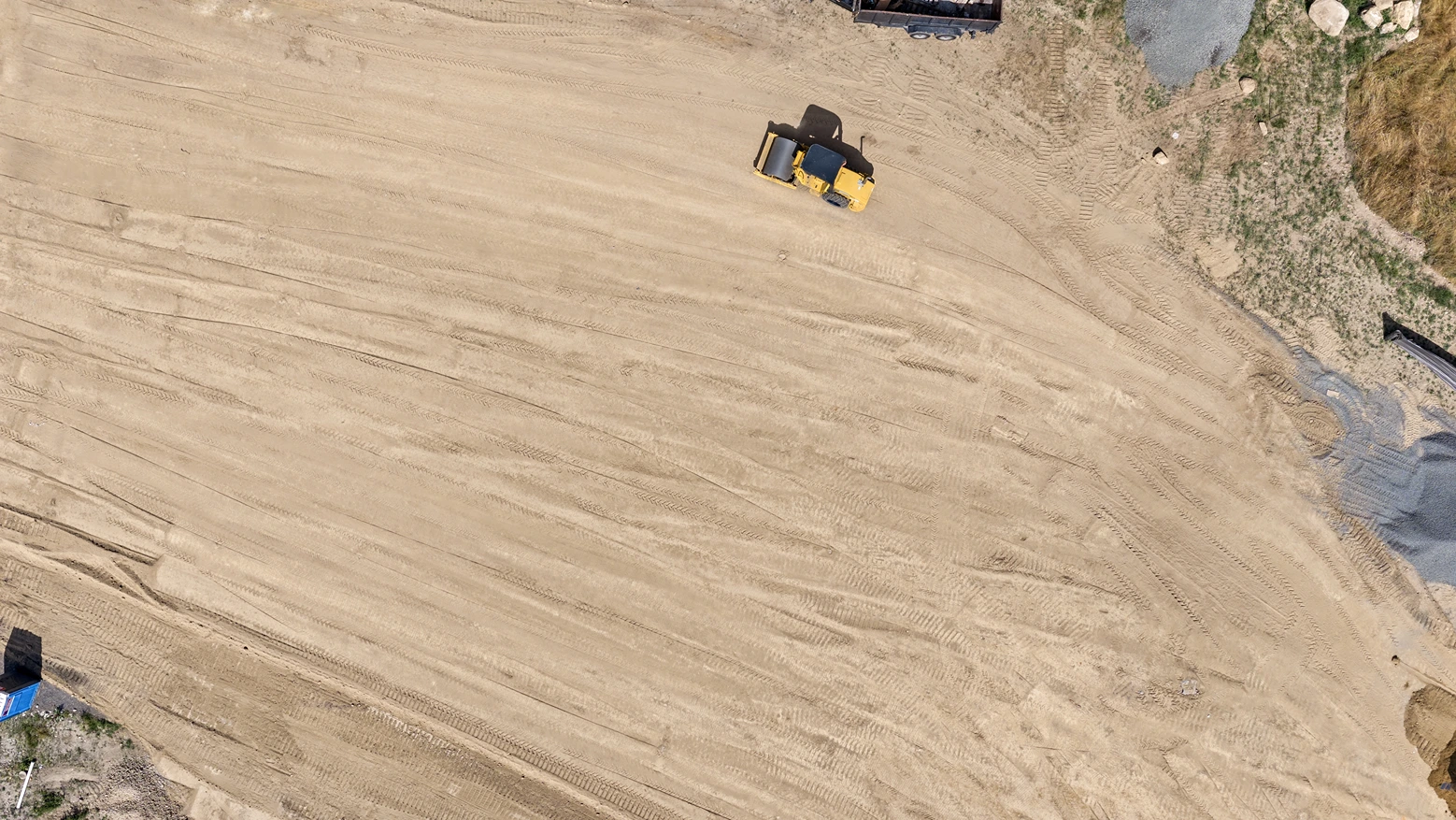
Tightens the rough grade to spec elevations and tolerances, with subgrade compacted for footings, slabs, walks and paving.

Last-pass shaping of the surfaces that stay exposed, set to final elevation and drainage for topsoil, landscape and lawn.

Roadway and access road subgrade cut, filled and compacted to the tolerance in the spec, ready for aggregate base and paving.

Moisture conditioning, compaction in lifts and proof rolling that ready the subgrade under building pads, slabs and paving.

Building pads cut, filled and compacted to the pad elevation and compaction values the plans and the soils report call for.

Parking fields and drive aisles graded to the design elevations and slopes on the plans, with subgrade prepped for paving.

Slope grading and benching, swale grading for drainage, and sports field and flatwork grading built to the design surface.
An estimator vetting a grading sub is asking two things: will the grade meet the spec, and will the pad be ready when the foundation crew is. On our jobs, dedicated grade operators handle the grading, backed by in-house grade checking and cross-trained crew members. Our largest project scope to date is $1.5M.
Track Record
Projects completed across the Greater Seattle area.

We submit a schedule with expected timelines, so the foundation crew and the subs after it can be booked against the pad handoff.

Every proposal lists the site assumptions behind the price. When the ground differs from the topo or the geotech report, we flag it early and lay out the options.

We also carry excavation, material handling and site preparation, so the earthwork stays with one contractor from the start.

We hold WA Contractor License MIGHTAE766QK and UBI 605-632-469, are registered in SAM.gov for federal work and belong to the AGC.
Grading moves through four stages in a fixed order, so the GC can see what's next and when the pad is due.
SEE OUR FULL PROCESS
We check the plans and specs against the site, verify existing conditions on a site walk and run an earthwork takeoff with cut and fill analysis, so import or export shows up in the bid. Design conflicts and drainage issues go to the geotech and civil before award.
Setup covers survey control, utility locates and TESC (temporary erosion and sediment control), which goes in before any ground is disturbed.
We rough grade to design, moisture condition fill and compact it in lifts, then prepare and proof roll the subgrade, and fine and finish grading bring the site to final elevation.
Grade gets checked against the design, density testing and special inspections are coordinated where the spec calls for them, and we walk the pad with the GC and hand over a documentation package.
The real test of a sub is whether a GC calls you for the next job. Here's what the contractors and developers we work with have to say.

From 220+ Google reviews
We take on site grading within a 50 to 70 mile radius of Seattle, reaching Tacoma to the south, Bellingham to the north and North Bend to the east. Plats, commercial builds and public works projects inside that range are within reach of our crews and equipment.
Seattle
Bellevue
Tacoma
Everett
Lynnwood
Bellingham
Granite Falls
North Bend


Home base & primary coverage
Grading tolerances come from the approved plans, the project specs and the engineer, and they shift with the scope, the soil and what the surface has to carry. That's why we don't publish one blanket number: a building pad and a landscaped area don't carry the same tolerance.
Bid documents use these three terms loosely. Here's how each stage differs and what it leaves for the next trade.
A grading line item covers more than leveling ground. Estimators often underestimate the prep it takes to reach subgrade elevation and compaction, which can include:
Existing soils, elevation changes and the coordination between excavation, underground utilities, foundations and paving add more. Pinning these down during estimating helps avoid unexpected costs and schedule delays.
When a pad misses elevation or compaction, the cost often lands on the trades that come after it. Common causes are poor compaction, elevations off the plan and drainage slopes that don't carry water, and one of the costliest is building on subgrade that was never properly prepared.
Avoiding that takes attention to soil conditions, lift thickness, moisture content and the plan elevations. The target on every handoff is a properly prepared, accurately graded subgrade the next contractor can work on without corrective work first.
Grading permit thresholds change from one jurisdiction to the next and are typically tied to yardage disturbed, slope or how close the work sits to a critical area. We work regularly under the grading requirements of the Seattle Department of Construction and Inspections (SDCI), King County, the City of Bellevue, Snohomish County and the City of Tacoma.
Grading costs vary too widely between sites for a published range to be useful, so every price comes from your plans and geotech report. Depending on the job, we bid lump sum, per cubic yard, per square foot of graded area or T&M with equipment rates, and a unit price schedule covers added scope.
Factors that affect grading cost:

Answers to what contractors and developers most often ask before bringing us onto a project.

Site grading shapes a property to the elevations, slopes and drainage on its civil plans by cutting, filling, leveling and compacting soil. The result is a stable, correctly draining base for foundations, slabs and paving.
Excavation is about moving material: digging out, hauling off or bringing in soil until the site reaches the depths and general elevations it needs, from foundations to trenches. Grading starts from there and shapes, levels and compacts the ground to the design elevations, slopes and drainage. Mighty Arm carries both scopes.
Grading cost depends on the site, so we don't publish a range. Yardage, cut and fill balance, tolerance, soil and moisture, access, season, slope, survey scope and testing all affect the price, and we price each job from the plans you send.
We build the grading schedule around your foundation date once we've reviewed the plans. Duration is driven by yardage, so there's no standard timeline, and the GC gets a staged schedule for sequencing the foundation crew and the trades after it.
Where the plans call for accessible routes, we grade to ADA slope requirements, verify slopes before paving and flag design conflicts. Under Section 403.3 of the 2010 ADA Standards, a walking surface with a running slope steeper than 1:20 (5%) must be built as a ramp, and cross slope can't exceed 1:48.
Our grading work runs under the project safety plan, with spotters around equipment, slope and bench safety, utility locates and potholing before digging, and traffic control on roadway grading.
When a compaction test fails because of our work, we re-grade the area so it can be tested again.
Our grading work carries a one-year workmanship warranty from substantial completion. Manufacturer warranties on supplied materials pass through to the owner, and the warranty excludes damage by others, settlement beyond normal tolerances, misuse and changes in site use. Grade is documented and verified at handoff, with as-built or grade certification on request.
Upload the civil set and geotech report, and our estimator will come back with a proposal covering scope, price and schedule.
Give us the basics and a quick description of the scope. We'll take it from there.

Commercial excavation, site prep, and demolition for general contractors and developers across Greater Seattle.
License: MIGHTAE766QK
UBI: 605-632-469


