Mighty Arm Excavation is a licensed, bonded and insured water utility contractor for GCs, developers and their estimators across Greater Seattle. We handle water main installation, domestic services and underground fire service lines as part of our underground utility work, built to purveyor standards.
Request a BidMighty Arm Excavation installs domestic water and fire service from the main to the building. The purveyor is the water district or utility that owns the system, and its standard details govern how the work is built.

Work is built to AWWA standards, NFPA 24, WSDOT/APWA specifications and the purveyor's standard details.
Pressure testing, disinfection and flushing are carried through to purveyor sign-off.
The scope falls under CSI Division 33: 33 10 00 Water Utilities and 33 14 00 Water Utility Transmission and Distribution.


Mighty Arm Excavation's water scope covers six parts.

We install 6" to 12" mains in restrained-joint ductile iron, PVC C900 or fused HDPE, with valves, fittings and thrust restraint.

Water service line installation covers 1" to 2" copper or PEX/polyethylene services, meter setters, meter boxes and irrigation services.

Underground fire sprinkler leads run from the main to the building, built to NFPA 24 and the approved plans.

We set fire hydrants, fire department connections (FDCs) and post indicator valves (PIVs) to the purveyor and fire marshal details.

Backflow assembly installation includes the vaults, double check detector assembly vaults among them. Each assembly is left ready for a certified backflow assembly tester.

We tie in to existing mains, and live taps are made by Mighty Arm, the purveyor or a tapping contractor, depending on the purveyor.
Mighty Arm runs water work with a dedicated utility crew, experienced with purveyor testing and disinfection and cross-trained with our earthwork crews.
Track Record
Projects delivered company-wide across Greater Seattle, private and public.

We schedule taps, shutdowns and inspections with the purveyor, and fire line inspections with the fire marshal, for the GC.
Domestic services, fire service lines, hydrants and backflow vaults go in under one scope and one sub.
Workmanship is warranted one year from substantial completion, and a test that fails due to our installation is re-worked at our cost. Manufacturer warranties pass through to the owner.
Mighty Arm's water installation moves through four stages: preconstruction, installation, testing and closeout.
SEE OUR FULL PROCESS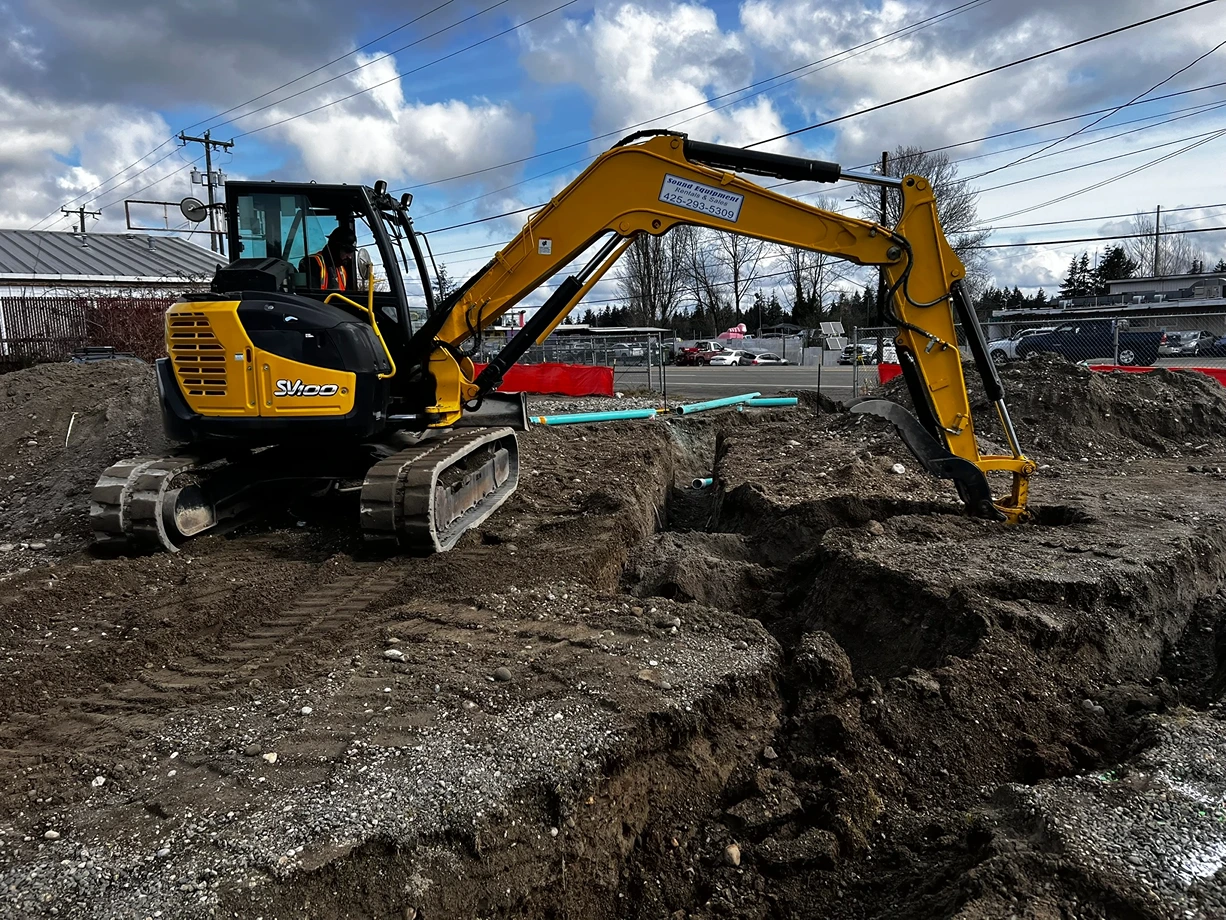
We review the civil plans and the purveyor's standard details, then line up taps and shutdowns with the purveyor. Fire service is coordinated with the fire marshal, and permits and 811 locates come before any digging.
The trench is excavated and bedded before the pipe, valves, fittings and thrust restraint go in. Hydrants, FDCs and backflow assemblies are set, and services are stubbed to the building.
The new line is pressure tested, disinfected and flushed, with bacteriological (bac-T) sampling coordinated for clearance. The purveyor and, on fire lines, the fire marshal inspect and sign off.
We backfill, compact and restore the surface, then hand as-builts for valves, hydrants and services to the GC. The GC provides the survey for the as-builts.
The real test of a sub is whether a GC calls you for the next job. Here's what the contractors and developers we work with have to say.

From 220+ Google reviews
Mighty Arm Excavation has installed water under four Greater Seattle purveyors:
Each purveyor sets its own standard details, tap procedures and inspection steps, and we build to the one that serves the site.
We cover the region from Tacoma to Bellingham and east to North Bend, including Bellevue and Granite Falls.


Home base & primary coverage
Mighty Arm installs the pipe the plans and the purveyor specify. Valve, fitting and hydrant brands follow the plans.
Thrust restraint holds pipe and fittings against the force water pressure puts on bends, tees and dead ends. Mighty Arm uses the method the plans call for:
Standards we build to:
A new water main goes through pressure testing, disinfection and bac-T clearance before the purveyor puts it into service. Washington's drinking water rules require disinfection to AWWA or other approved standards, and satisfactory bac-T samples from a state-certified lab.
If a pressure test fails, Mighty Arm takes these steps:
Why timing matters: incomplete pressure testing, disinfection or bac-T clearance can hold up final utility approval and occupancy, so testing is lined up early.
Mighty Arm Excavation carries underground fire line installation from the main to the building, built to NFPA 24 for private fire service mains. Fire marshal inspection is coordinated alongside the purveyor's sign-off.
The fire service scope covers:
Fire sprinkler leads: the underground supply line from the main to the building.
Fire hydrant installation: hydrants set to the purveyor and fire marshal details.
FDC (fire department connection): the connection the fire department pumps into.
PIV (post indicator valve): a buried valve with a post showing whether it is open or shut.
Double check detector assembly vault: a backflow assembly with a metered bypass that detects leaks or unauthorized use.
Washington's cross-connection rules have purveyors require a double check assembly on most fire protection services.
Who makes the connection to a live main depends on the purveyor. Mighty Arm can perform wet taps, the purveyor may make the tap itself, or a tapping contractor may handle it.
Wet tap (hot tap): connects a new line to a main while the main stays in service.
Tie-in: connects new pipe to an existing main, often during a scheduled shutdown.
How a live-main connection runs:
Mighty Arm schedules the connection with the purveyor.
Approvals are secured and inspections are arranged.
Utility personnel or an approved tapping contractor, our crew and the utility inspector are on site, as the connection requires.
Lead time: GCs often underestimate purveyor lead times, since connection fees, shutdown scheduling, permits, inspections and testing all affect cost and schedule. Allow several weeks. In Seattle, SPU estimates about 3 months on non-arterial streets and 4 months on arterials for its water service installation, counted from payment.
Mighty Arm Excavation keeps water apart from sewer and storm by planning alignments before any trench opens.
Confirm existing utility locations and elevations before excavation.
Set trench alignments to hold the required horizontal and vertical separation.
On tight sites, coordinate approved adjustments or protective measures with the engineer and the utility authority.
When Mighty Arm also carries the sewer and storm, all three systems are laid out together.
Mighty Arm runs water work to the project safety plan, with these controls in place.
Trench safety plan and a competent person on site
Confined space entry procedures for meter and backflow vaults
Traffic control for right-of-way work
811 locates and potholing before digging
Sanitary handling of potable water pipe and fittings
Mighty Arm prices water work per project from your plans and the purveyor's requirements, with each part of the scope on its own line.
On the Cloverdale 22-home site in Seattle, Mighty Arm installed over 1,000 feet of water alongside the sewer, storm and electrical work.
We take on water work on these project types:
Credentials for prequalifying us:
These are the questions GCs and developers most often ask before awarding the water scope.

Yes. Mighty Arm Excavation installs underground fire sprinkler leads to the building, fire hydrants, FDCs, PIVs and double check detector assembly vaults. The work is built to NFPA 24 and the purveyor's details. Fire lines go through fire marshal inspection, which we coordinate for the GC.
It depends on the purveyor. Mighty Arm can perform wet taps, the purveyor may make the tap itself, or a tapping contractor may handle it. Either way, Mighty Arm schedules the connection, approvals and inspections with the purveyor.
Yes. Mighty Arm Excavation carries pressure testing, disinfection and flushing through to purveyor sign-off and coordinates bac-T sampling for clearance. If a test fails due to its installation, Mighty Arm repairs and re-tests at its own cost. Backflow assemblies are tested by a certified backflow assembly tester.
A single water service typically takes 1 to 3 working days of fieldwork, once permits, materials and utility coordination are in place. A water main extension with hydrants can take several weeks of construction, and permitting and purveyor scheduling can extend the overall timeline significantly. Bring Mighty Arm in at preconstruction so purveyor lead times can be lined up early.
Yes. Mighty Arm installs sanitary sewer, storm drainage and water on the same site, so the GC can award the underground utilities to one sub. The sewer and storm scope is on the underground utilities page.
A Washington State-certified backflow assembly tester (BAT) tests the assembly, typically a qualified third-party specialist. Mighty Arm Excavation handles the excavation, the vault and the assembly installation.
Tell us the project, the purveyor and when you need water at the building. We'll come back with mains, services, fire lines and taps priced as separate lines.
Give us the basics and a quick description of the scope. We'll take it from there.

Commercial excavation, site prep, and demolition for general contractors and developers across Greater Seattle.
License: MIGHTAE766QK
UBI: 605-632-469
NAICS: 238910 – Site Preparation Contractors