Mighty Arm Excavation is a licensed, bonded and insured storm drainage contractor for GCs and developers across Greater Seattle. We install the conveyance, detention, infiltration and treatment on the civil plans as part of our underground utility scope.
Request a BidMighty Arm Excavation carries storm drain installation from the first catch basin to the outfall. The work is built to the manual and civil set your jurisdiction applies. The storm drainage system goes in to the rim and invert elevations on the drawings, so it drains and inspects as the engineer designed it.
Storm is one of the three wet systems we self-perform, alongside sewer and water. Excavation, grading, pipe, infiltration trenches, structure setting, rock and media placement, backfill and compaction stay with Mighty Arm. Crane services, landscape planting and some concrete or asphalt restoration are brought in as the job needs them.

We build to the Ecology, King County and City of Seattle stormwater manuals, WSDOT/APWA specs and the project civil specs.
As-builts of rims, inverts and structure locations go to the GC, from survey data the GC provides.
The CSI scope is 33 40 00 Stormwater Utilities, 33 41 00 Storm Utility Drainage Piping and 33 49 00 Storm Drainage Structures.


Mighty Arm installs six groups of storm work to the civil plans, from conveyance through treatment.

We lay storm drains, storm lines and storm mains to laser line and grade. Pipe options include PVC, HDPE dual-wall, ductile iron, reinforced concrete and corrugated metal.
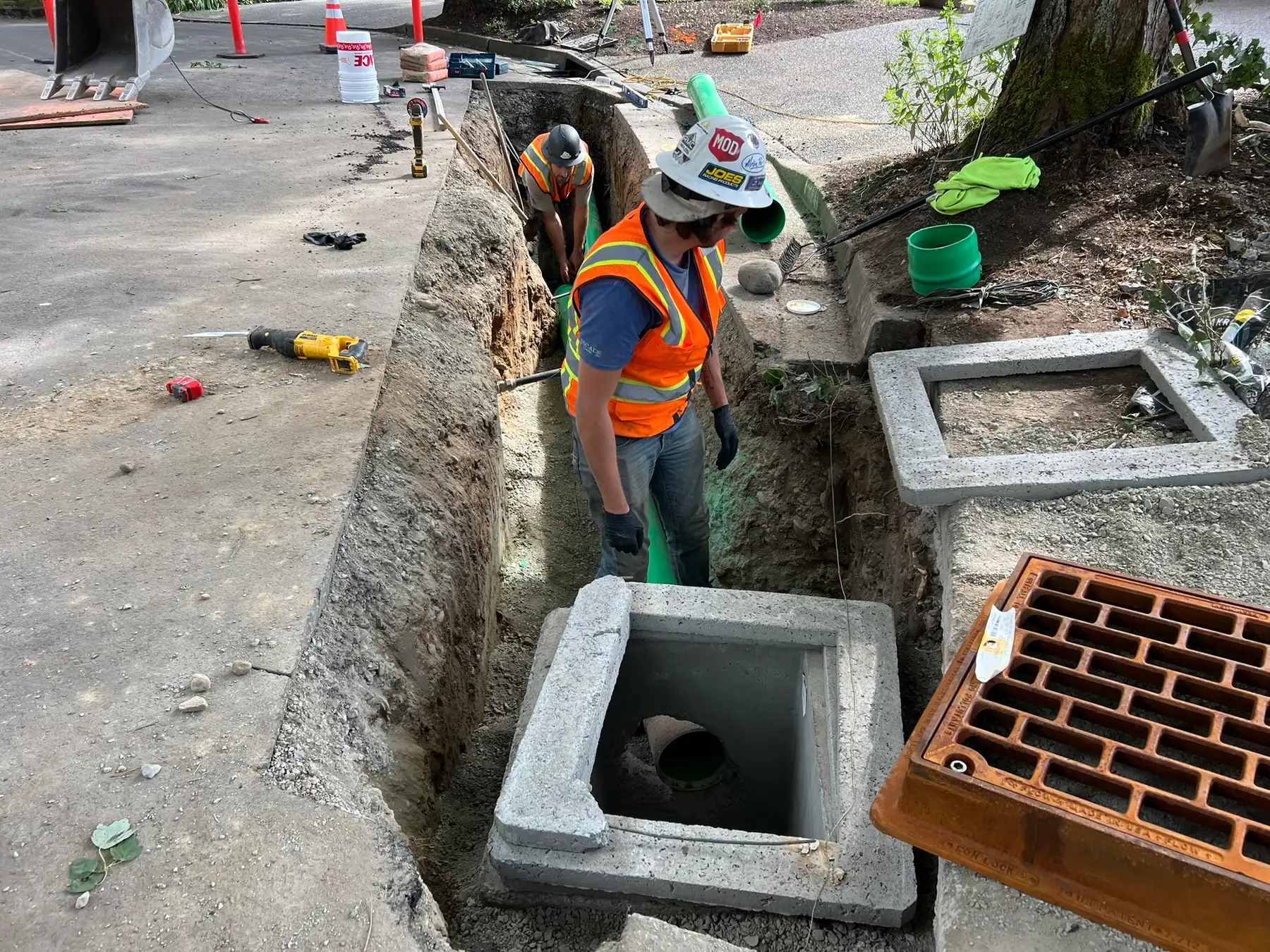
We install footing drains, roof drain and downspout connections, trench drains and area drains. Curtain and French drains go in with perforated pipe.

We handle catch basin installation for Type 1 and Type 2 structures, plus storm manholes, outfalls and flow control structures. A flow control structure, or control manhole, limits how fast detained water leaves the site.

We build underground detention systems in pipe or chambers, set precast detention vaults, and cut retention and detention ponds to the flow control design.
We build low impact development (LID) facilities: infiltration trenches, drywells, rain gardens, bioretention planters that filter runoff through planted soil, and permeable pavement subgrade.

We set sand/oil separators, oil/water separators and cartridge storm filters to the treatment design, including CONTECH StormFilter structures.
With Mighty Arm, one subcontractor carries the whole storm system to sign-off. As a commercial drainage contractor, we back that with four commitments.
Track Record
Projects delivered company-wide across Greater Seattle, private and public.

Pipe, structures, detention, infiltration and treatment run through one subcontractor, so the storm line, structures and vault aren't split between subs.
Runoff, stockpiles and site traffic stay off infiltration areas until the soils around them are stabilized.

Our dedicated utility crew is cross-trained with the earthwork and TESC crews, so temporary and permanent drainage are sequenced together.

Workmanship is warranted one year from substantial completion, and manufacturer warranties pass through. If a test or inspection fails because of our installation, we redo the work at our cost.
A Mighty Arm storm install moves through preconstruction, installation, testing and inspection, then closeout.
SEE OUR FULL PROCESS
We review the civil and drainage plans, confirm rim and invert elevations and connection points, and check infiltration assumptions with the geotech. Permits within our scope and 811 locates come before any digging.
Structures are set to grade and pipe is laid to laser line and grade, with drain rock, fabric and media placed to spec. Infiltration facilities stay protected from sediment as the work moves. Grades and elevations are checked throughout installation. Wrong slopes or structure elevations, poor bedding and sediment in infiltration systems are common storm defects we see on other sites.
Lines get CCTV inspection, structures are flow tested, and PIT tests are coordinated with the geotech. A PIT test, or pilot infiltration test, measures how fast water soaks into native soil. The jurisdiction's inspector then walks the system for sign-off.
Trenches are backfilled and compacted in lifts, and structures are cleaned before turnover. As-builts go to the GC.
The real test of a sub is whether a GC calls you for the next job. Here's what the contractors and developers we work with have to say.

From 220+ Google reviews
Mighty Arm installs storm systems under Seattle (SPU and SDCI), King County, Bellevue, Snohomish County and Tacoma. As a stormwater contractor with offices in Bellevue, Seattle and Granite Falls, we cover the region from Tacoma to Bellingham and east to North Bend. Jurisdictions differ in the manual, standard plans and inspections they apply, and we build to the ones on your permit.


Home base & primary coverage
Mighty Arm builds to the stormwater manual your jurisdiction applies, with the pipe, structures and media the civil set specifies. Jurisdictions across Western Washington apply Ecology's 2024 Stormwater Management Manual for Western Washington or an equivalent local manual. King County uses its Surface Water Design Manual, now the 2026 edition. Seattle's Stormwater Code and Manual were updated effective July 1, 2026.
Our excavators set structures within their rated lifting capacity. When weight, reach or site conditions call for more, we bring in a crane and work to a lift plan. Precast catch basins, manholes and other structures come from project-approved suppliers. Bioretention soil mix is bought to the specified blend, and we place it.
Mighty Arm protects infiltration facilities from sediment from the day they are built until the site is stabilized. A trench, drywell, bioretention cell or permeable pavement section that loads with fines during construction may not infiltrate as designed.
In Seattle, bioretention in the public right-of-way that will become a City asset needs special inspection. The applicant selects and pays the special inspector. The contractor attends the SDOT preconstruction meeting and coordinates with the applicant when each inspection is due.
When native soils don't infiltrate the way the design assumed, Mighty Arm pauses the affected work and notifies the GC, civil engineer and geotech. We document the conditions in the excavation. Work on that facility resumes after more testing or an approved design revision. Design infiltration rates come from the geotech's testing, and field soils can differ.
Mighty Arm handles groundwater at vault and detention excavations with dewatering pumps and sediment treatment as needed. Before the structure is set and backfilled, we coordinate with the project engineer on foundation stability, bedding and flotation. Flotation is the uplift a high water table puts on an empty vault or tank. The dig itself sits within our retention and detention excavation work.
Mighty Arm sequences storm drainage with the TESC plan and site grading, so temporary and permanent drainage work together. Our TESC crews set erosion and sediment controls before clearing or earthwork starts.
Where storm crosses sewer or water, we pothole early to confirm locations and elevations. We follow the approved separation details, and any revised crossing is approved by the engineer and utility owner before it is installed.
Storm drain installation cost depends on the system on the plans. Mighty Arm prices each storm scope from the civil set rather than publishing ranges. The proposal states the scope, assumptions and exclusions behind the number.
GC estimates most often underestimate the work around the system: deep vault installs, shoring, groundwater, soil export, imported aggregate and restoration. Large precast structures can carry long lead times and need crane coordination. Utility conflicts, inspections and protecting infiltration facilities also affect cost and schedule.
For preliminary planning, a straightforward single-home drainage system may take several working days to a couple of weeks. A plat-wide system may take several weeks to several months, depending on size, depth, structures, site conditions and phasing. Material lead times, permits and inspections add to that. Commercial work is billed progressively on Net 30 or Net 60 terms, with prevailing wage and certified payroll on public jobs.
Mighty Arm's storm work runs from single-home drainage to plats, condo and townhome sites, private commercial, public works, federal and right-of-way projects.
Answers to what contractors and developers most often ask before bringing us onto a project.

Mighty Arm sets precast detention vaults with its excavators when the structure is within their rated lifting capacity. A crane comes in, working to a lift plan, when weight, reach or site conditions require it. Groundwater, bedding and flotation are coordinated with the engineer before the vault is set. Mighty Arm's experience setting large precast includes a detention vault near Tacoma.
Mighty Arm installs sand/oil separators, oil/water separators and cartridge storm filters along with the rest of the storm system. Its experience includes CONTECH StormFilter structures, such as the 54-inch StormFilter manhole it set on a Sammamish site.
Mighty Arm builds the subgrade and storage layer of permeable pavement facilities to the civil specs, as on its Cloverdale site in Seattle. Sediment-laden runoff, stockpiles and traffic stay off the section until the surrounding soils are stabilized. Responsibility for the pervious surface course is set out in each proposal.
Mighty Arm installs TESC before clearing or earthwork. It then keeps sediment-laden runoff, stockpiles and construction traffic away from storm and infiltration facilities with erosion controls and designated access routes. Infiltration facilities are timed to limit exposure until soils are stabilized, and structures are cleaned before turnover.
Mighty Arm self-performs sanitary sewer, storm drainage and water as one underground utility scope, and can carry the earthwork alongside them. One subcontractor then holds grade, bedding and compaction across all three systems.
For preliminary planning, Mighty Arm estimates several working days to a couple of weeks for a straightforward single-home drainage system. A plat-wide system may take several weeks to several months, depending on system size, depth, structures, site conditions and phasing. Material lead times, permits and inspections add to that.
Send the civil set, the drainage report and your schedule. We'll come back with the storm scope priced and the site assumptions written into the proposal.
Give us the basics and a quick description of the scope. We'll take it from there.

Commercial excavation, site prep, and demolition for general contractors and developers across Greater Seattle.
License: MIGHTAE766QK
UBI: 605-632-469
NAICS: 238910 – Site Preparation Contractors