Mighty Arm Excavation is a sewer contractor for general contractors and developers across Greater Seattle, licensed, bonded and insured in Washington. We install side sewers, sewer mains, manholes and live tie-ins as part of our underground utility work, from excavation through testing and district sign-off.
Request a BidMighty Arm Excavation carries sanitary sewer installation from a single side sewer to a main extension for a plat. The scope covers side sewers, mains, manholes, cleanouts, grease interceptors and force mains, plus excavation and setting for pump stations and grinder pumps.
GCs award it on its own, with our site preparation and earthwork, or in a wet utility package with storm and water. We also repair and replace side sewers on existing properties.

Built to WSDOT/APWA Standard Specifications and district and city standard plans
As-builts to the GC, who provides the official survey data
CSI Division 33 scope: 33 30 00 Sanitary Sewerage Utilities, 33 31 00 Sanitary Utility Sewerage Piping and 33 39 00 Sanitary Utility Sewerage Structures


We build all sewer work to the civil plans and the owning agency's standards.

We handle side sewer installation and sewer lateral replacement, typically in 4" to 6" pipe, plus repairs on existing properties.

We handle sewer main installation, typically 8" to 12", for plats, commercial sites and district main extensions, with stub-outs for future connections.
We set precast manholes in 48", 54" and 60"+ sizes, drop manholes, cleanouts, and doghouse or saddle manholes over existing mains.

We connect to live sewer mains, with bypass pumping where flow has to keep moving.

We set precast grease interceptors and traps to grade and connect them to the side sewer.

We cap and abandon sewers before a structure comes down, coordinated with the demolition scope and its permits.
Mighty Arm Excavation carries the trench, the pipe and the backfill under one scope, so the sewer has one accountable sub. We are public works and prevailing wage ready.
Track Record
Projects delivered company-wide across Greater Seattle, private and public.

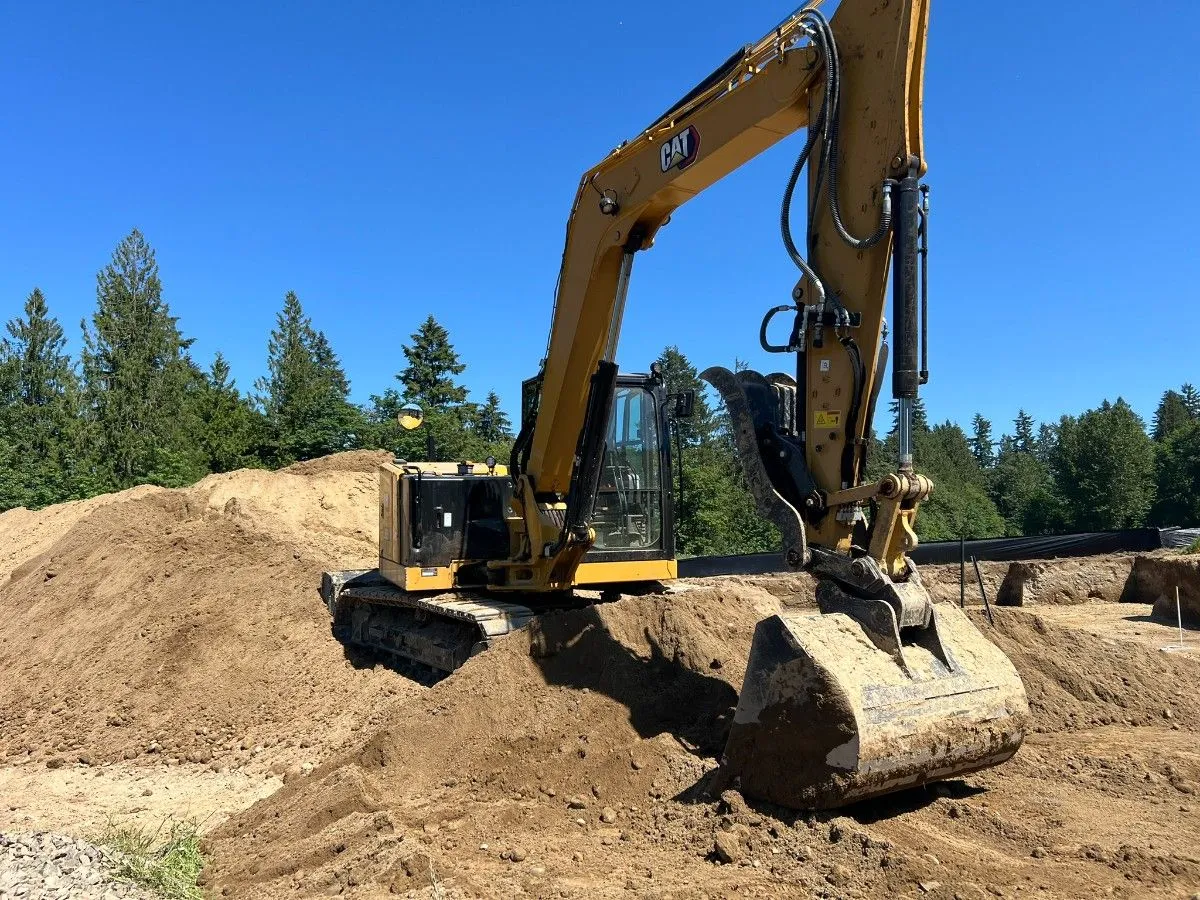
A dedicated utility crew, cross-trained with our earthwork crew, digs, shores, sets structures and backfills. Our pipe layers are experienced with laser grade. Coring is the one task we typically subcontract.
We have built to the standards of five metro sewer agencies, from SPU to Soos Creek.
The full wet utility package can sit with one subcontractor, alongside the earthwork.

Our workmanship carries a one-year warranty from substantial completion, with stated exclusions. Manufacturer warranties are passed through.
The sewer scope runs in four stages, from plan review to as-builts in the GC's hands.
SEE OUR FULL PROCESS
We review the civil plans and district standards and confirm inverts (the pipe's inside bottom elevation), connection points and crossings. Potholing verifies existing utilities. We pull permits and request 811 locates at least two full business days before digging, as state law requires.
Crews set up traffic control for right-of-way work, excavate and shore the trench, dewater as needed and place bedding to spec. Pipe goes in to laser line and grade, followed by manholes, cleanouts and the live tie-in to the existing main.
Pipe and manholes get the air, mandrel or vacuum tests the spec requires, and our crew typically runs the CCTV inspection. We schedule and attend the district inspection through sign-off.
Backfill is compacted in lifts, and surfaces are restored, including right-of-way paving where it applies. As-builts go to the GC.
The real test of a sub is whether a GC calls you for the next job. Here's what the contractors and developers we work with have to say.

From 220+ Google reviews
Mighty Arm Excavation has worked under five sewer agencies in the metro, each with its own standard plans and bedding and backfill rules. They are Seattle Public Utilities, King County Wastewater Treatment Division, Soos Creek Water & Sewer District, Northshore Utility District and Woodinville Water District. From offices in Bellevue, Seattle and Granite Falls, we cover Tacoma to Bellingham and east to North Bend, including Bellevue and Snohomish County.


Home base & primary coverage
Mighty Arm builds to WSDOT/APWA Standard Specifications and the project civil specs. District and city standard plans, such as SPU's or Bellevue Utilities', govern too.
A drop manhole carries an incoming pipe down to the manhole's invert through a vertical drop, so flow doesn't fall through the open structure. Sewer pipe bedding and backfill follow each jurisdiction's own requirements.
Mighty Arm performs or coordinates the tests the spec calls for, then schedules and attends the district inspection. If a test fails because of our installation, we do the rework at our cost.
Sewer work commonly fails inspection because of wrong slope, low spots that hold water, poor bedding, or leaking and poorly seated joints. Our crews check grade, pipe support and connections throughout installation.
Sewer often runs deeper than the other utilities on a site, so shoring and groundwater control are priced into the bid. We have completed multiple installs at 12 feet and can go deeper.
Washington requires cave-in protection for workers in an excavation (WAC 296-155-657). The exceptions are cuts entirely in stable rock, or under 4 feet where a competent person sees no sign of a potential cave-in. Our trench excavation runs to a trench safety plan, with a competent person on every crew.
A live main connection is coordinated with the district or city first and approved before backfill.
Bypass pumping moves sewage around the work area through temporary pumps and lines while the connection is made. Connections include manholes cored or set over the existing main. In Seattle, SPU does all work on existing City sewer pipes unless it pre-authorizes and observes it. SPU core taps 6", 8" and 10" laterals itself.
When an existing utility is off the plans or crosses the sewer grade, Mighty Arm pauses that area until an approved fix is in place. Inverts that don't match the plans and unmarked or misplaced utilities are conditions every sewer bid should allow for.
Potholing in preconstruction finds many conflicts early. On a Mercer Island side sewer, the crew found an existing asbestos pipe at the connection point, and the scope expanded to handle it safely.
Mighty Arm prices sewer work from the civil plans and site conditions, and every number comes back as a bid.
GCs commonly underestimate the work beyond laying pipe: deep excavation, shoring, groundwater, utility conflicts, soil export and imported backfill, and pavement restoration. Permits, inspection availability, traffic restrictions and district or city coordination add to cost and schedule, especially in the right-of-way.
Mighty Arm's sewer work runs from single-home side sewers to plats, condos, townhomes, commercial sites, right-of-way work, district main extensions, public works and federal jobs.
Answers to what contractors most often ask before bringing us onto a sewer scope.

Sewer depth is set by the civil plans and varies by site, and Mighty Arm has completed multiple installs at 12 feet. Shoring is matched to depth and soil, from trench boxes and slide rail to sloping, benching or engineered shoring. A competent person is on every crew.
Yes. Mighty Arm coordinates the connection with the district or city and gets approvals first. The crew exposes the main and installs the approved connection while managing flow, with bypass pumping where needed. Testing and agency approval come before backfill. Coring is typically subcontracted, and in Seattle, SPU core taps 6" to 10" laterals.
Yes. Mighty Arm performs or coordinates low-pressure air, mandrel, manhole vacuum, water exfiltration and CCTV testing, and it schedules and attends district inspections. If a test fails because of Mighty Arm's installation, the rework is at its cost.
Mighty Arm pulls side sewer permits. A side sewer is the pipe that carries wastewater from a building to the public sewer. In Seattle, an SPU side sewer permit is needed to connect to the public sewer or to build, repair, abandon or cap a side sewer.
Mighty Arm stops work in that area, verifies the main's location and elevation, and notifies the GC and project engineer. It then works with the utility owner and inspector on an approved fix that keeps sewer slope and required clearances. Potholing in preconstruction catches many conflicts before the trench opens.
Yes. Mighty Arm carries sewer, storm and water as one wet utility package and can bundle it with the earthwork and site prep. One sub then owns the trench, the bedding and the backfill across all three systems.
Ideally, bring Mighty Arm in during preconstruction, before plans and schedules are final. That lets us review connection locations, depths, access, conflicts and permits, so the GC can budget accurately and avoid delays.
For planning, a straightforward side sewer may take a few working days, and a main extension several weeks or longer. Permitting, agency coordination, inspections, testing and restoration can extend the overall schedule, and we set the timeline after reviewing the plans and site conditions.
Send the civil plans, the start date and the district or city that owns the main. We'll come back with the sewer scope priced and the depth, groundwater and tie-in assumptions written into the proposal.
Give us the basics and a quick description of the scope. We'll take it from there.

Commercial excavation, site prep, and demolition for general contractors and developers across Greater Seattle.
License: MIGHTAE766QK
UBI: 605-632-469
NAICS: 238910 – Site Preparation Contractors